
Tire Alignment Basics



Proper tire alignment is critical to the tread-life of your tires as well as to your car's steering performance. Improper alignment typically produces uneven tread-wear (figure H) either to the inside or outside shoulder of your tire. Simple alignments, at the proper intervals, will save you money in the long run in tire costs. It's best to have your car aligned at least once a year.
Alignment Spec: Camber
If your tires are wearing faster on one side or the other, your camber probably needs adjustment. Camber is the angle of the wheel against level ground when viewed from the front of the vehicle. If the top of the wheel leans out(figure I), then you have positive camber.
If the bottom leans out (figure J), then you have negative camber.
For most vehicles, at highway speeds, slightly negative camber works best.

Alignment Spec: Toe-Setting
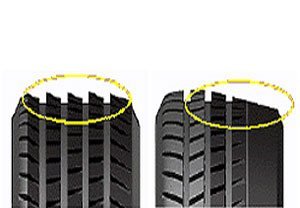
If your car's tires have a "saw-tooth" wear pattern (figure K), it's likely due to an incorrect toe setting. This measurement indicates whether your tires are parallel when the car is pointed straight ahead.
Toe-in means that the fronts of the tires are closer together and pointing towards each other (figure L), while toe-out means the opposite -- that the fronts are pointing slightly away from each other (figure M).

Zero-toe -- or perfectly parallel tires -- is typically best for street-driving.
Racing Factoid: Race cars may have the camber and toe of their tires adjusted in various ways to adapt to different race-track conditions, degrees of banking, etc.
