Free Auto Mechanic

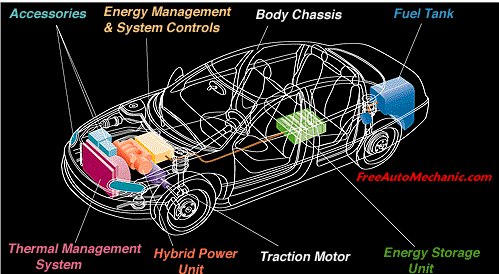
Hybrid-electric vehicles (HEVs) combine the benefits of gasoline engines and electric motors and can be configured to obtain different objectives, such as improved fuel economy, increased power, or additional auxiliary power for electronic devices and power tools.Compare Hybrids Side by Side


Hybrid Technolgy


Both technologies come together in hybrid electric vehicles, also known as HEVs or hybrids. Present-day hybrids are equipped with ICEs and electric motors. A hybrid's ICE engine(Internal Combustion Engine), as in any ICE-powered car, produces power through continuous, controlled explosions that push down pistons connected to a rotating crankshaft. That rotating force (torque) is ultimately transmitted to the vehicle's wheels.


How Much Better is Hybrid Car Gas Mileage?

In certain driving modes, hybrid electric gas cars offer you no better fuel efficiency than standard cars. Also the fuel efficiency of Hybrid cars and SUV's works counter intuitive to what you would expect. Your gas mileage could be more volatile with a hybrid vehicle due to the way it operates in different driving modes, and how much time you spend in each driving mode. In some driving modes, your fuel efficiency can be better, and in some modes your fuel efficiency can offer you no benefit at all. We will give you enough information here to help you decide if a hybrid vehicle is right for you. But first, let's clear the air on the common myths and misconceptions of hybrid vehicles.

Stop blaming the President, stop blaming the oil companies and Congress about oil prices!

Everyone wants to blame everyone else for their problems. Don't blame the President or oil companies for high gasoline prices. If you want to blame someone, go into the bathroom and point into the mirror, because it's your fault! It's my fault, it's everyone's fault. Sure oil companies took advantage and charged a bit more in 2005, making record profits, that's called capitalism dudes. You sell your camera on eBay and it bids way up because the demand is there to support it. Is that someone's fault? But think about this, oil companies would not have had a leg to stand on with pricing if the demand for fuel from you and I were not so great. We all drive around in gas guzzling SUV's. Think about it, in 1994, there were very few SUV's on the market. Remember the 70's? Riding bikes to work, carpooling? Hardly anyone does that anymore. China's insatiable demand for oil, cement, and lumber had not kicked in yet. The population was a lot lower than, and there were fewer houses requiring electricity and heating oil. So the fault here lies with you and I much more than the President or Congress oil companies. Instead of complaining about their record profits, buy their stock! China alone was the root cause of the largest increases in lumber and cement the last 2 years. All of us need to do what we can to conserve oil, not just with our cars, but in conservation and recycling of other resources we use that depend on oil. We need to attack this from multiple angles. Hybrid vehicles are one of many steps that we should be implementing. Hybrid cars CLAIM a 40% to 60% improvement in fuel efficiency for city driving. Just think if all of us drove hybrid cars, what that would do to the demand for gasoline. It does not take much of a drop in demand for oil at all to tip the scales and cause prices to drop.

Hybrid Myths:

I have assembled here some common myths that you might hear from your drunk Monday morning quarterback neighbor about hybrid vehicles.

Hybrid Car Myth #1: Hybrid cars need to be plugged in to charge them. You'll hear this one a lot. It is an old wives tale repeated by people who have no idea what they are talking about. Maybe they are just trying to justify the fact that they can't afford a hybrid.

Hybrid Car Myth #2: Hybrid cars get over 70 MPG! Again, this is false, most hybrids have EPA mile per gallon city ESTIMATES in the 30's to 50's best case. The fuel economy ratings for hybrid cars on the highway is slightly worse than the standard fuel only counterparts. With my driving habits, I can easily wipe out all the gains a Hybrid car gives you.

Hybrid Car Myth #3: The Hybrid's rechargeable battery only lasts for 2 years! Thank you for playing! Unlike standard 12 V lead acid car batteries, the eco-friendly rechargeable NiMH hybrid batteries usually come with 8 year warranties, and are designed to last that long too.

Hybrid Car Myth #4: If I run out of gas, I can keep driving on the electric motor! Nice try. Hybrid cars rely on the gas engine most of the time, and won't function unless the gas engine is functioning. But if your electric motor quits working, your gas motor will run on its own and still allow you to drive the car as a normal car. If your hybrid runs out of gas, and you really want to be foolish enough to try driving it anyway, call me first so I can come shoot video to send into MTV's Jackass.

Hybrid Vehicle Technology: Theory Of Operation Through 5 Driving Modes

Welcome to Hybrid theory 101. Hybrid cars operate differently depending on your current driving modes. We can divide your typical driving into 5 different modes. Your hybrid car acts differently in each of these 5 driving modes, in some modes the electric motor is operating, and some modes the gasoline engine is operating, and sometimes both are operating. Knowing how your hybrid vehicle operates under each mode is crucial to getting the most gas mileage, and minimizing emissions output. Of course the car makers don't tell you this, they just make it sound like you always get super high gas mileage like a Bingo free spot, no matter how you drive, but that may not be the case. Here are the 5 hybrid vehicle driving modes and their theory of operation:

1) Full Stop: At a full stop, like at a red traffic light or stop sign, the gas engine usually shuts off to eliminate idling, and reduce emissions. The electric motor is now ready to propel the car when push on the gas pedal. This is usually pretty seamless, and you might not even notice without seeing it on the power monitor indicator. In crowded cities with lots of stop and go traffic like the opening scene of Office Space, this can save you a lot of fuel.

2) Low Speed/Initial acceleration from a stop: First of all, I should point out that being a scofflaw maniac driver, I never drive in this mode. Starting from a stop, and driving in a normal sane, just-like-your-grandmother acceleration from the stop line, the electric motor usually propels your car, powered by the electric motor's battery pack. This type of downtown stop and go traffic is where you save the most fuel with hybrids, counter intuitive to normal gas engines, where you burn the most fuel. The electric motor works up until about 15 MPH without any help from the gas engine. The gas engine turns on and off as needed while you drive. I have zero patience for losers at stoplights. If you have a life to live and a lead foot like me, your hybrid SUV will be less efficient in this mode, because flooring the accelerator will demand extra power, causing the gas engine to kick in. This eliminates the fuel savings potential offered to you by your electric motor during this driving mode. Also, if you spend all day in stop and go traffic, the constantly used electric motor battery may discharge quicker, causing the gas engine to turn back on to charge the battery. So your fuel economy savings for hybrids may really only benefit you in a much more narrower range of operating conditions than the car makers will admit. Moral of the story: If you don't drive your hybrid car like you are supposed to, don't expect to get the advertised fuel economy.

3) Heavy Acceleration: This is my personal favorite mode of operation. This mode quickly puts a lot of forward distance between you and the aforementioned losers at stoplights, stuck there during indecision attacks when the light turns green. Here your power comes from both the gas engine, AND the high torque electric motor, typically through some type of power splitting device. During this mode, you probably will not be saving as much fuel as you expect from all the advertising.

4) Highway Driving: This is where the fuel efficiency of Hybrid cars and SUV's works counter intuitive to what you would expect. The reason is that in this driving mode, the car is typically powered only by the gas engine, which may be charging your electric motor battery pack at the same time. So the electric motor is not typically contributing during highway driving, meaning your hybrid vehicle is just another gas guzzling, car at highway speeds. If you are a highway commuter that drives an hour to work each way on the open highway with no stop and go traffic, a hybrid vehicle will probably offer you little fuel savings.

5) Braking, Coasting and Deceleration: When you brake or coast, forward kinetic energy that in standard car normally gets dissipated as heat is instead converted to electric energy. This is accomplished by using the old reliable spinning electrical motor in it's other role, now as a generator to charge the battery pack. This is why hybrid cars never need to be plugged in, despite old wives tales you might hear. This process of charging the battery is known as regenerative braking.

6) Backing Up: Ok I lied, there's a sixth mode, but who really counts going in reverse as a driving mode? In reverse the gas engine does not operate, the electric motor does all the work. Not that this will add huge amounts of fuel savings for you. I drive about 50 feet max in reverse on a daily basis. Now maybe if you're Burt Reynolds...

Online Auto Repair Manuals On Sale for $11.99 . Get the same information the dealers use that include TSB's, Belt routing, repair procedures, color wiring diagrams and more.

 
Logo
Content ©Copyright 2006-2009 by FreeAutoMechanic.com. All Rights Reserved | Privacy Policy | Site Map | User Agreement | Search | Advertise