Knock Sensor
Knock Sensor
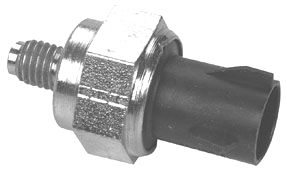
OPERATIONThe knock sensor is used to detect engine detonation (spark knock). As a result, a voltage sent to the PCM will retard spark timing. The Knock Sensor is a piezoelectric accelerometer with the sensor designed to resonate at approximately the same frequency as the engine knock frequency. The Knock Sensor uses the resonant frequency to mechanically amplify the vibrations. This method allows relatively large signals to be achieved without electrical amplification and with small package size.
To prevent the replacement of good components, be aware that the following non-EEC areas may be at fault:
•Fuel (quality)
•Fuel (octane)
•Basic engine
•Spark timing
The sensor has a thin circular piezoelectric ceramic disk which is bonded to a metal diaphragm. Electrical connections are made through a two pin integral connector.
What does a Knock Sensor Do?
- A Knock Sensor is used to detect engine detonation (spark knock).
- It sends a voltage signal to the powertrain control module (PCM) (12A650) .
- Is able to provide a signal which retards the ignition timing, as necessary.
Knock Sensor Replacement
Knock Sensor Removal
-
Disconnect battery ground cable.
-
Raise vehicle on hoist.
-
Disconnect engine control sensor wiring from knock sensor.
-
Remove heat shield boot from knock sensor.
-
Remove knock sensor from cylinder block.
Knock Sensor Installation
-
Follow removal procedure in reverse order.
-
Tighten knock sensor to 15-20 Nm (11-14 lb-ft).
-
Install heat shield boot over knock sensor.

Voltages are specific for each different vehicle engine. You may refer to your repair manual for Specific Voltages for testing. No manual at home/shop. You may also purchase an Online Auto Repair Manual for just $19.95 that can be accessed right now over the net. Includes repair procedures, trouble codes, wiring diagrams and more.
Knock Sensor

Car Engine Sensors :
- Powertrain Control Module (PCM)
- Throttle Position (TP) sensor
- Mass Air Flow (MAF) sensor
- Intake Air Temperature (IAT) sensor
- Idle Air Control (IAC) valve
- Engine Coolant Temperature (ECT)
- Heated Oxygen Sensor (HO2S)
- Camshaft Position (CMP) sensor
- Knock Sensor (KS)
- Vehicle Speed Sensor (VSS)
- Crankshaft Position (CKP) sensor
- Engine Trouble Codes