VSS - Vehicle Speed Sensor
Vehicle Speed Sensor (VSS)
OPERATION
The Vehicle Speed (VSS) Sensor input is used by the PCM to determine vehicle speed. The VSS generates a signal that increases in frequency proportionate to vehicle speed. The PCM has a base frequency stored in memory for a distance of one mile. By comparing the input and stored value, the PCM calculates vehicle speed.
VSS types include: photo-optic, permanent magnet generators(The Vehicle Speed Sensor (VSS) is a magnetic pick-up that sends a signal to the Powertrain Control Module (PCM).) or hall effect technology. The PCM may use other sensors on the vehicle (ABS Wheel Speed) to validate VSS operation.
VSS information is used to calculate vehicle loads including: torque converter application, cruise control, fuel cutoff/speed governance strategies, instrument panel speedometer and more.
Modified drivetrain components such as final gear sets and/or tires can alter VSS input values to the PCM. Improper signals can alter Torque Converter Clutch (TCC) application, shift points, cruise control operation as well as many other systems relying on vehicle speed input.
The sensor measures the rotation of the transmission and the PCM determines the corresponding vehicle speed. A faulty speed sensor due to loose connections, bad grounds, high resistance in the circuit, or opens in the circuit can cause the following symptomsVehicle Speed Sensor Symptoms
- Overheated transmission
- Increased emissions
- Poor fuel economy
- Stalling on deceleration
- Improper shift points
- Cruise control inoperative
Vehicle Speed Sensor Testing
- Turn the ignition switch to the OFF position.
- Disengage the wiring harness connector from the VSS.
- Using a Digital Volt-Ohmmeter (DVOM), measure the resistance (ohmmeter function) between the sensor terminals. If the resistance is 190–250 ohms, the sensor is okay.

Vehicle Speed Sensor Replacement
REMOVAL & INSTALLATION (older models)The VSS is located half-way down the right-hand side of the transmission assembly.
- Apply the parking brake, block the rear wheels, then raise and safely support the front of the vehicle on jack stands.
- From under the right-hand side of the vehicle, disengage the wiring harness connector from the VSS.
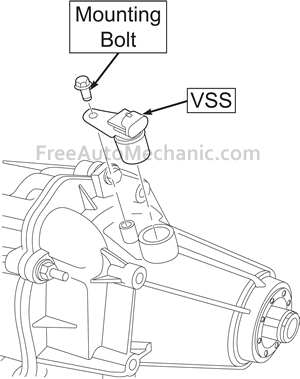
- Loosen the VSS hold-down bolt, then pull the VSS out of the transmission housing. To remove the VSS, detach the wiring harness connector from it . . . then remove the hold-down bolt and bracket. . . and slide the sensor out of the transmission case
- To install:
- If a new sensor is being installed, transfer the driven gear retainer and gear to the new sensor.
- Ensure that the O-ring is properly seated in the VSS housing.
- For ease of assembly, engage the wiring harness connector to the VSS, then insert the VSS into the transmission assembly.
- Install and tighten the VSS hold-down bolt to 62–88 inch lbs. (7–10 Nm).
- Lower the vehicle and remove the wheel blocks.
REMOVAL & INSTALLATION (newer models)
- Disconnect electrical plug
- Remove mounting bolt

Car Engine Sensors :
- Powertrain Control Module (PCM)
- Throttle Position (TP) sensor
- Mass Air Flow (MAF) sensor
- Intake Air Temperature (IAT) sensor
- Idle Air Control (IAC) valve
- Engine Coolant Temperature (ECT)
- Heated Oxygen Sensor (HO2S)
- Camshaft Position (CMP) sensor
- Knock Sensor (KS)
- Vehicle Speed Sensor (VSS)
- Crankshaft Position (CKP) sensor
- Engine Trouble Codes